

A Guide to Diving in Malta, Gozo and Comino
and dive deeper
Diving in Malta: Wrecks, Caves and Crystal Clear Waters
From the shore, Malta’s sea is inviting enough. Beneath the surface, it becomes another landscape entirely.
Descend into the clear Mediterranean water and limestone cliffs continue underwater, opening into caves, reefs and rocky passages. Elsewhere, shipwrecks rest on the seabed, some deep enough to challenge experienced divers. Sunlight travels surprisingly far through the clear water, illuminating rock formations and giving divers excellent visibility in favourable conditions.
It is this variety that makes diving in Malta so rewarding. Across Malta, Gozo and Comino there are more than 120 dive sites, ranging from accessible shore dives to caves and deeper wrecks.
And you do not need to arrive with years of experience. A first dive can be just as memorable as an advanced wreck dive. The trick is choosing an experience that matches your ability and letting the conditions on the day guide where you go.
Why is diving in Malta one of the Mediterranean’s standout experiences?
Part of the answer is visibility. The water around the Maltese Islands is remarkably clear, allowing the underwater scenery to become part of the experience rather than simply the backdrop.
Then there is the sheer choice.
You can spend one dive moving around a wreck and the next exploring limestone caves. Malta offers both shore and boat diving at different depths, while Gozo and Comino add their own caves, rock formations and underwater landscapes.
For experienced divers, night diving changes the atmosphere again. Once daylight disappears, a torch picks individual colours out of the darkness and familiar rock formations suddenly feel quite different.
This combination of wrecks, caves, clear water and relatively close dive sites is at the heart of the appeal of scuba diving in Malta.
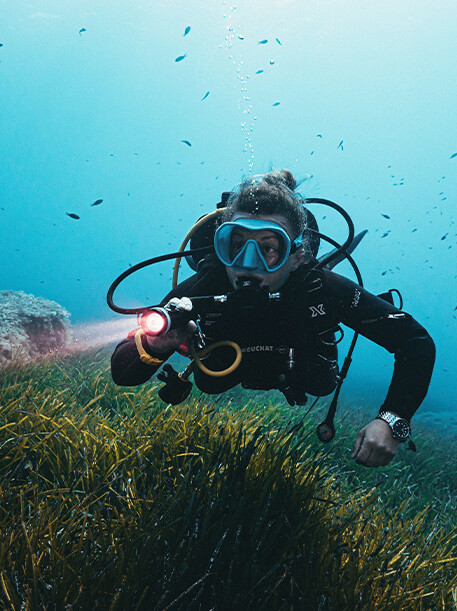 Diving Holiday in Malta.
 Divers exploring wrecks under the sea.
Is scuba diving in Malta suitable for beginners?
Absolutely.
For many visitors, Malta is where diving begins rather than where an established diving hobby continues. Professional diving schools offer introductory experiences that allow complete beginners to discover what breathing underwater actually feels like.
There is usually some theory first, followed by training in controlled water before progressing to the sea with an instructor. That first descent can feel strange for a few moments. Then the noise of the surface disappears, your breathing settles and suddenly you are looking at Malta from an entirely new perspective.
Those who want to go further can take a recognised diving course in Malta during their holiday. Recognised diving qualifications can be obtained from the age of 10, making diving an option for some families with older children as well as adults.
Where can you experience the best scuba diving in Malta?
There is no single best site. What makes Malta interesting is how different one dive can feel from another.
Explore the Um El Faroud
Just off the coast of Wied iż Żurrieq, the Um El Faroud rests on the seabed at a maximum depth of around 35 metres.
There is something inherently atmospheric about approaching a large wreck underwater. Its shape gradually becomes clearer through the blue and what first appears as a shadow begins to reveal its scale.
The surrounding southern coastline is impressive above water too, making Wied iż Żurrieq an excellent setting for a day built around the sea.
Dive the wrecks around Ċirkewwa
Northern Malta is another important area for wreck diving. The Rozi and P29 are among the recognised sites around Ċirkewwa, with depths reaching approximately 36 metres.
The north also places divers close to Comino and Gozo, so it works particularly well for visitors planning several days in the water rather than a single dive.
Discover the Blue Hole in Gozo
Anyone considering scuba diving in Malta and Gozo should leave room for Dwejra.
Above the surface, the landscape is rugged and dramatic. Beneath it, the Blue Hole provides one of Gozo’s best known diving environments, surrounded by the island’s characteristic limestone geology.
Gozo also offers deeper sites including the MV Karwela at Xatt l Aħmar, Double Arch and Reqqa Point.
Enter the Santa Maria Caves at Comino
Comino is famous for its bright blue water, but there is another world beneath it.
The Santa Maria Caves reach a maximum depth of around 10 metres and provide a very different experience from Malta’s deeper wreck sites. Moving through the rocky underwater landscape, with sunlight filtering through the water around you, shows why caves are such an important part of diving across the Maltese Islands.
Stay local in Qawra
The Imperial Eagle lies off Qawra Point at a maximum depth of around 40 metres, giving experienced divers another wreck to consider in northern Malta.
For guests staying at AX ODYCY, having diving opportunities nearby also means less time travelling across the island before getting into the water.
What if you are already an experienced diver?
This is where diving holidays in Malta become particularly interesting.
Rather than repeating similar dives, experienced visitors can move between wrecks, caves, reefs and deeper sites across the three islands. Professional centres can recommend locations appropriate to your certification and adjust plans according to sea conditions.
Equipment rental is widely available through diving centres too, so bringing a complete set of gear from home is not always necessary.
Keep some flexibility in your plans. Malta enjoys a favourable climate, but wind and rough seas can make one coast unsuitable while conditions elsewhere are considerably better. Your dive centre in Malta should always have the final say on what is appropriate on the day.
Not ready to dive? Try snorkelling in Malta
You do not need a tank to discover what lies beneath Malta’s clear water.
Snorkelling in Malta is an easy way to add an underwater experience to a beach or boat day, particularly for families and groups where not everyone wants to scuba dive.
The rocky nature of much of Malta’s coastline means the underwater scenery can begin remarkably close to shore. In clear, sheltered water, simply putting on a mask can reveal rock formations and marine life that are invisible from the beach.
Comino is an obvious choice for snorkelling in Malta, while sheltered bays around Malta and Gozo provide plenty of alternatives. Always choose somewhere suited to your swimming ability and the conditions that day.
Planning scuba diving holidays in Malta
If diving is going to shape your holiday, staying in the north of the island makes planning each day much easier.
AX ODYCY in Qawra is well placed for reaching several of northern Malta’s established diving areas, including Qawra Point and Ċirkewwa, while Gozo and Comino are also within easy reach for divers looking to explore beyond the main island.
The location works particularly well when you want to balance time underwater with a more relaxed resort stay. After a morning dive, you can return to Qawra for time by the sea, a leisurely meal or a slower afternoon around the resort.
For beginners, experienced divers and anyone planning several days in the water, AX ODYCY provides a convenient base for scuba diving holidays in Malta without making the entire trip feel centred around diving alone.
Before you take the plunge
A good diving holiday starts with flexibility.
Speak to a professional centre about your experience before choosing sites and be realistic about your certification. Malta’s deeper wrecks are tempting, but the best dive is the one suited to your ability and the conditions on the day.
If you have your own mask or other personal equipment that you prefer using, bring it. Larger items can usually be hired locally. Swimwear, sun protection and something warm to put on after a dive are useful additions to the bag.
And do not overfill the itinerary. Part of the pleasure of diving in Malta is surfacing somewhere beautiful with nowhere you urgently need to be next.
FAQs about Diving in Malta
Diving is possible throughout the year thanks to Malta’s generally favourable climate. The warmer months bring higher air and sea temperatures, while diving outside peak summer can mean fewer visitors. Whatever the season, wind and sea conditions determine which sites are suitable on a particular day, so always follow the advice of your diving centre.
Divers can encounter a variety of Mediterranean marine life around reefs, caves and rocky habitats. The experience varies by site, depth and season, and the underwater scenery itself is a major part of Malta’s appeal.
Not for a supervised introductory dive. Complete beginners can try scuba diving with a qualified instructor without already holding a diving certification. If you want to dive independently within the limits of a recognised qualification or visit more advanced sites, you will need the appropriate certification and experience.
Yes. Malta has professional diving schools offering beginner courses and recognised qualifications. Recognised diving qualifications are available from the age of 10, so a holiday can be enough time to take your first steps towards becoming a certified diver.
Yes. Professional centres across the islands provide instruction, guided dives and equipment rental for different experience levels. Beginners can arrange introductory sessions and courses, while qualified divers can book excursions suited to their certification.
There is no single standard package. Depending on the operator, a diving holiday may include guided dives, tanks, weights, equipment rental, transport to dive sites and training. Accommodation and meals may be separate. Check exactly what your chosen centre includes before booking, particularly if you intend to dive on several days.
Yes. Malta’s clear water and rocky coastline make snorkelling an excellent option for visitors who want to experience the underwater environment without scuba equipment or training. It is particularly easy to combine with beach days, boat trips and visits to sheltered bays.
Pack swimwear, sun protection, a reusable water bottle and something comfortable to wear between dives. If you have a mask or other personal diving equipment you particularly like, it can be worth bringing it, but complete equipment sets can be rented locally. Certified divers should also bring proof of their qualification and any documentation requested by their chosen centre.
The combination is difficult to beat: clear Mediterranean water, more than 120 dive sites, caves, reefs, wrecks and both shore and boat diving across Malta, Gozo and Comino. The short distances between many sites also give diving centres options when conditions differ from one coast to another.